
Dynamic measurement of frequency and ROCOF in modern power electricity networks
Dynamic measurement of frequency and ROCOF in modern power electricity networks
When there is a sudden change in the electrical network due to a fault, which is likely to result in a loss of generation or loads, there is an immediate imbalance between generation and demand, causing a change in the power frequency. The greater the power imbalance or the weaker the network, the greater the frequency derivative (ROCOF). The faster the countermeasures are activated to compensate, the less dangerous the frequency nadir will be.
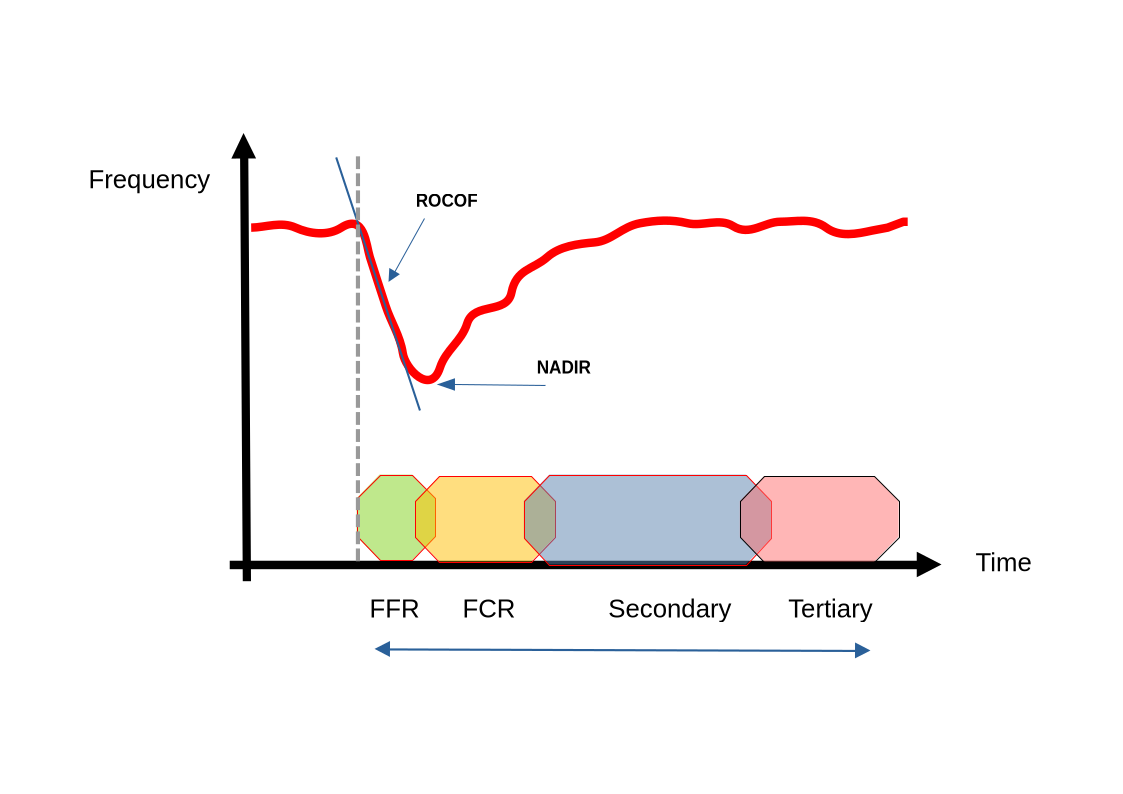
FFR (Fast Frequency Response/Reserve) can usually react in no less than 0.5 seconds based on the frequency drop. FCR (Frequency Containment Reserve), also known as Primary Reserve, takes at least a couple of seconds, usually around half a minute.
The major challenge for existing frequency algorithms is the time needed to deliver a reliable frequency measurement, which is usually at least a hundred milliseconds. Furthermore, frequency measurements may be unreliable during transients, which could lead to false triggering.
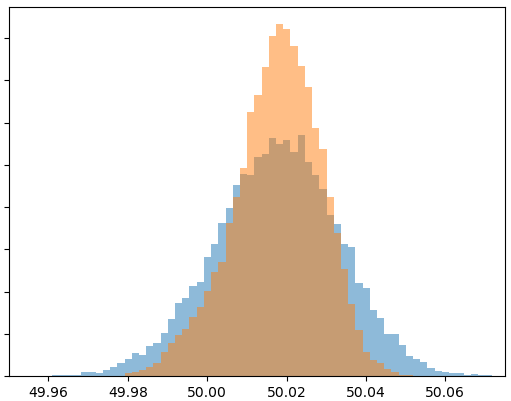
Our patented method easily solves this issue by providing much faster frequency measurements. Additionally, as uncertainty accompanies each measurement, unusual frequency readings during fast transients and angle jumps can be disregarded. No matter what happens in the network, you will always know the frequency reading every 10 milliseconds, or whether you will need to jump to a wider averaging window. This gives any control system certainty and strength. Bear always in mind that our method brings a frequency measurement as the result of averaging hundreds or thousands of simultaneous estimations, and this is the reason for the intrinsic delivery of the uncertainty of the resulting frequency measurement.
However, if the underlying generation complex — be it a BESS, PV farm or wind park — is willing to emulate the behaviour of robust synchronous machines, then an even faster frequency response is required. Why wait until the frequency has changed so much before taking action? It would be more efficient to start acting when the frequency slope changes, before anything has been detected in the frequency recordings. This is exactly what big rotating machines do with their built-in inertia.
Measuring this slope, usually called ROCOF (Rate of Change Of Frequency), is very challenging for any existing equipment, so it is typically evaluated in no less than 0.5 seconds. This completely disregards the intrinsic behaviour of synchronous generators. In fact, the method used to evaluate ROCOF is usually as simple as measuring the difference in frequency between two distant timestamps. This method only takes two measurements, but yields poor results when the time difference is reduced. This is why a time difference of at least 500 ms is usually used.
By contrast, our patented method independently evaluates the ROCOF, regardless of the final frequency recording. Within each power cycle, rather than calculating the average frequency based on hundreds or thousands of simultaneous recordings, these values are plotted alongside their time propagation to create a cloud of points that can be linearly approximated. This provides the average slope within just one or several cycles, together with its uncertainty and, most importantly, its coefficient of determination, which is always between 0 and 1 and is an elegant measure of how well the calculated slope fits the actual derivative. Even when high ROCOFs are measured, it is easy to assess whether they are real. Long time windows and faith are no longer required for acceptable ROCOFs; now, it can be lowered down to just one power cycle.
Finally, all the calculations are executed on the fly, producing several tens of variables every 10 milliseconds, which can be used by any fast control system.
When the active power response is intended to be proportional to a certain frequency gap, we are dealing with Limited Frequency Sensitive Mode (LFSM). Many curves have been defined worldwide. The device's online measurements provide a reliable, granular response with almost no latency to any situation.
Another important application of the device is electrical protection. In fact, load shedding and asset protection based on the measured frequency are key issues for DSOs and TSOs. In this case, the measurements must be both fast and accurate to eliminate transients that could produce false readings and random triggering.
A challenging application in this sense is the detection of unintended islands. There are many methods of detecting this phenomenon, which are classified as either active or passive. Active methods, which are built into most power electronic inverters, involve injecting disturbances into the network in the expectation that it is sufficiently strong not to be affected. However, when an electrical island appears, the network is not strong enough and the voltage and/or frequency exceed certain thresholds that trigger a protection mechanism, resulting in disconnection from the DSO.
Recently, however, concerns have arisen as these inverter-based resources have become an important part of the generation spectrum, as their strength is comparable to that of the network itself and well above the capacity of conventional synchronous generation. This could perhaps lead to subsynchronous oscillations in the network.
On the other hand, passive methods have always been less effective. However, our patented method provides an immediate frequency measurement and ROCOF, which indicate the presence of an unintended island.
Also, RMS voltages are also calculated along the periods of frequency that have been determined, rather than being averaged across the number of cycles above or below the exact cycle count. This represents the true voltage quantity for each frequency measurement.
Last but not least is the important issue of subsynchronous oscillations (SSO), which are difficult to eliminate from today's power networks. Although they should not occur, they are like potholes in the road; they will always be present. When they do occur, TSOs and DSOs attempt to reconfigure the network to alter their eigenvalues, but this can sometimes have a worse effect (e.g. the 2025 Spanish blackout). If they exist, PSSs in synchronous generators are a common remedy for intra- and inter-area oscillations, although tuning them is very challenging and depends on the network itself. Furthermore, they struggle to dampen two simultaneous frequencies.
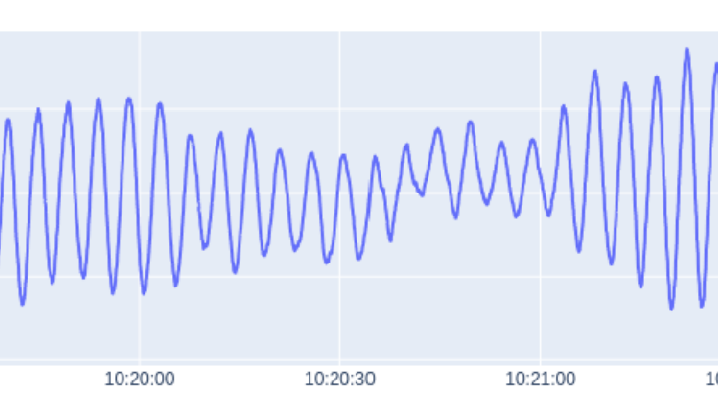
However, the UNDAM uMETER 500 incorporates a cutting-edge, proprietary module that can quickly self-adjust to true subsynchronous oscillations. With automatic tuning, it can output a sequence of power bumps directly to the PPC, BESS, or any control system. When implemented across a region, it can dampen oscillations quickly and effectively, thereby preventing damage to generators and passive elements and helping to stabilise the system.
There is a general tendency to confuse inertia with damping. In fact, a synchronous generator is not an effective damper, which is why a PSS is required if damping is mandatory. Furthermore, damping in a synchronous condenser is less effective as there is no infeed of active power; therefore, the energy of the oscillation cannot easily be dissipated or compensated for with mechanical surplus. In contrast, the UNDAM uMETER 500 provides the correct signals to counteract the energy of the oscillation, thus reducing its amplitude progressively.
In conclusion, our method can be likened to a Swiss army knife in terms of its frequency, ROCOF and voltage measurement capabilities. This enables a wide range of challenging and demanding applications that can enhance the stability and performance of power electricity networks and devices.
Necesitamos su consentimiento para cargar las traducciones
Utilizamos un servicio de terceros para traducir el contenido del sitio web que puede recopilar datos sobre su actividad. Por favor revise los detalles en la política de privacidad y acepte el servicio para ver las traducciones.